Research theme
The Third Law of thermodynamics
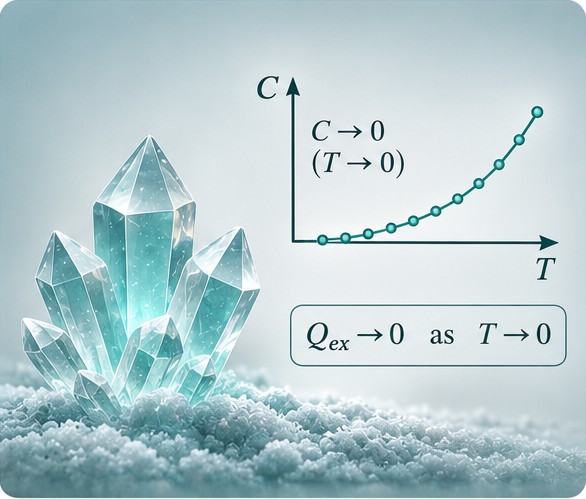
Nernst’s heat theorem says that as the temperature approaches absolute zero, systems become increasingly reluctant to exchange heat: entropy differences and heat capacities vanish. I ask whether, and under which conditions, this law survives for systems that are driven away from equilibrium.
About this research
In a driven system a steady heat flux persists even at very low temperature, so the usual statement of the Third Law cannot be applied directly. The meaningful quantity is the excess heat: the extra heat exchanged during a slow change of a parameter, such as the temperature of the environment, on top of the steady dissipation. The question is whether this excess heat, and with it the nonequilibrium heat capacity, vanishes as the temperature goes to zero.
For a large and physically motivated class of Markov jump processes, it does. Unlike in equilibrium, however, a condition on the dynamics is needed: the dynamical activity at low temperature must stay high enough that relaxation towards the dominant state does not take dramatically different times from different starting states. If this condition fails, the system localises dynamically away from its main dissipative structure, and the heat capacity can instead be strongly enhanced at low temperature.
The proofs rely on bounds for the quasipotential obtained from graphical representations, such as tree-loops, and from mean first-passage times. Close to equilibrium the heat capacity derives from an entropy and always vanishes at zero temperature, so any violation of the extended Third Law is a genuinely nonlinear effect.
Publications
- 2024
Close-to-equilibrium heat capacity
F. Khodabandehlou, C. Maes
J. Phys. A: Math. Theor. 57(20), 205001 (2024), arXiv:2307.11551
- 2023
The vanishing of excess heat for nonequilibrium processes reaching zero ambient temperature
F. Khodabandehlou, C. Maes, I. Maes, K. Netočný
Ann. Henri Poincaré (2023), arXiv:2210.09858
- 2023
A Nernst heat theorem for nonequilibrium jump processes
F. Khodabandehlou, C. Maes, K. Netočný
J. Chem. Phys. 158, 204112 (2023), arXiv:2207.10313
- PhD
Nonequilibrium Graph Theory and Third Law of Thermodynamics
PhD thesis, KU Leuven (2024)