Research theme
Nonequilibrium response theory
How does a system that is kept out of equilibrium respond when we change it a little, or slowly? In equilibrium the answer comes from thermodynamic potentials and fluctuation–dissipation relations. For steadily driven systems the response is richer, and I study its structure, from small Markov systems to macroscopic dynamics such as the Lorenz model of convection.
About this research
When the parameters of a driven system change, the change itself induces extra flows on top of the steady ones: excess entropy flux, excess heat, excess currents and excess dynamical activity. Around a nonequilibrium steady state this response need not be the derivative of any thermodynamic potential, and the familiar equilibrium relations between response coefficients can fail.
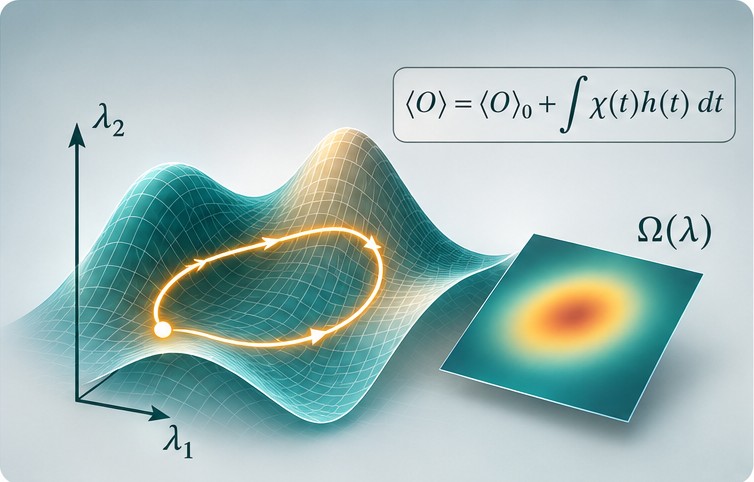
For Markov jump processes that satisfy local detailed balance but may be strongly driven, the response to slow, cyclic changes of parameters takes a geometric form, described by a Berry phase with a Berry potential and Berry curvature. A non-zero Berry curvature measures how far the Maxwell relations and the Clausius heat theorem break down, and a simple model shows an analogue of the Aharonov–Bohm effect: a non-zero Berry phase along a path where the curvature itself vanishes.
Response theory also needs a sound thermodynamic bookkeeping. In the Lorenz model of convection, we construct the dissipative and driving terms so that they satisfy local detailed balance, which identifies the thermodynamic force, the entropy production and the frenesy of the flow. The resulting model shows a transition from a quiescent fixed point to a robust relaxation oscillation, close to the recharge–discharge pictures used for El Niño: a long, nearly reversible recharge phase alternates with a brief, frenetic burst in which almost all activity and entropy production is concentrated.
Publications
- 2026
Local Detailed Balance in the Lorenz Model Replaces the Butterfly with Frenetic Bursting
F. Khodabandehlou, C. Maes
Preprint, Google Scholar
- 2026
Quasistatic response for nonequilibrium processes: evaluating the Berry potential and curvature
A. Beyen, F. Khodabandehlou, C. Maes
J. Phys. A: Math. Theor. 59(20), 205001 (2026), Google Scholar