Research theme
Nonequilibrium graph theory
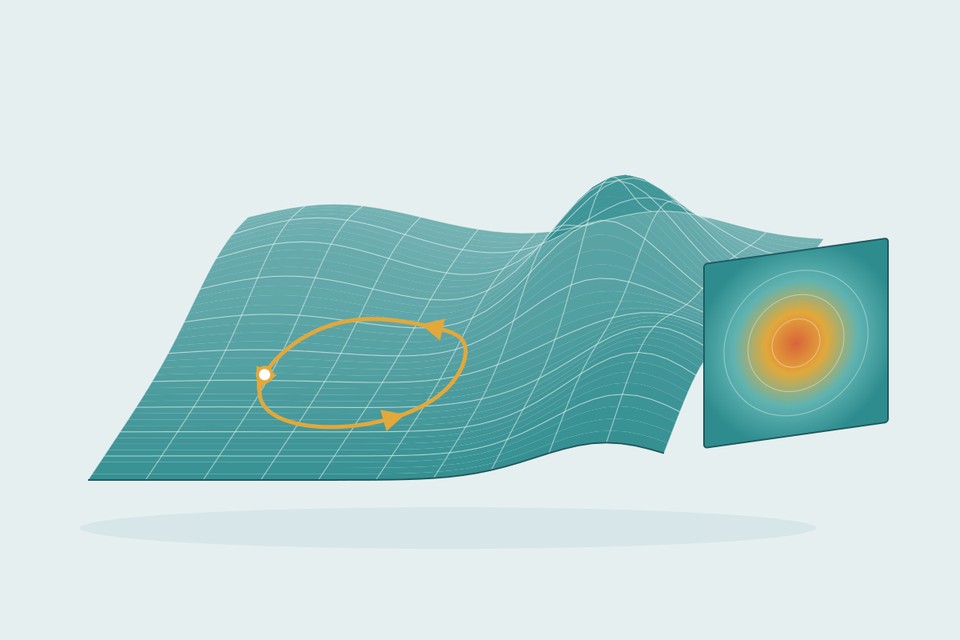
Many quantities that describe a nonequilibrium system, from its stationary distribution to its heat capacity, can be written as sums over trees and forests drawn on the graph of its states. These graphical representations turn linear algebra into combinatorics that one can see, and they lead to exact formulas and sharp bounds.
About this research
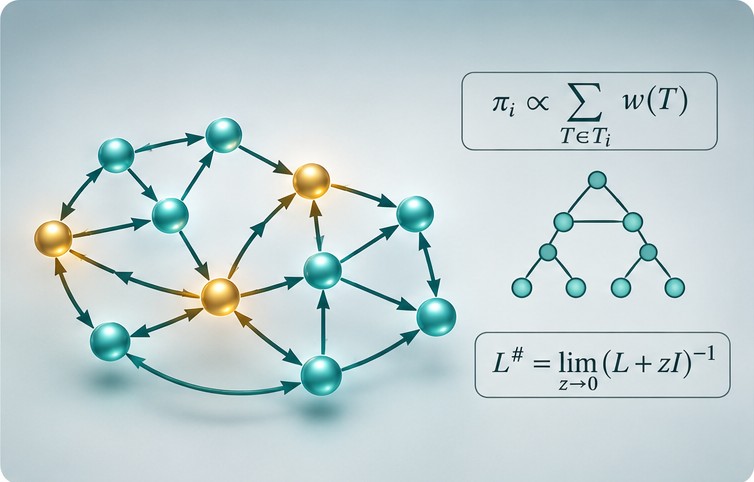
A Markov jump process lives on a graph: the vertices are the states of the system, and the edges are the allowed transitions with their rates. Kirchhoff’s matrix-tree theorem expresses the stationary distribution as a sum over the spanning trees of that graph, and the matrix-forest theorem extends this idea to many other quantities.
A central object is the Poisson equation for the generator of the process. Its solution, the quasipotential, governs excess heat, relaxation and response. We give it a graphical form in terms of spanning forests and relate it to mean first-passage times, which yields bounds that stay useful when the system is large or the temperature is low. A graphical representation of the Drazin inverse of the generator, and the enumeration of trees and forests, also give exact nonequilibrium heat capacities for driven walkers on a ring and for active particles on a graph.
The same tools apply to currents. When the rates on one edge are changed, any other steady current depends on the current through that edge in an affine way. Using mean first-passage times, we derive this relation, give the current-current susceptibility a physical interpretation, and extend it to several currents at once, where the relation remains affine but is no longer additive.
Publications
- 2024
Affine relationships between steady currents
F. Khodabandehlou, C. Maes, K. Netočný
J. Phys. A: Math. Theor. 58(15), 155002 (2024), arXiv:2412.05019
- 2024
On the Poisson equation for nonreversible Markov jump processes
F. Khodabandehlou, C. Maes, K. Netočný
J. Math. Phys. 65, 043301 (2024), arXiv:2310.19219
- 2023
The vanishing of excess heat for nonequilibrium processes reaching zero ambient temperature
F. Khodabandehlou, C. Maes, I. Maes, K. Netočný
Ann. Henri Poincaré (2023), arXiv:2210.09858
- 2023
Drazin-inverse and heat capacity for driven random walkers on the ring
F. Khodabandehlou, I. Maes
Stoch. Proc. Appl. 164, 337–365 (2023), arXiv:2204.04974
- 2022
Exact computation of heat capacities for active particles on a graph
F. Khodabandehlou, S. Krekels, I. Maes
J. Stat. Mech. 2022, 123208 (2022), arXiv:2207.11070
- 2022
Trees and forests for nonequilibrium purposes: an introduction to graphical representations
F. Khodabandehlou, C. Maes, K. Netočný
J. Stat. Phys. 189, 41 (2022), arXiv:2207.02521
- PhD
Nonequilibrium Graph Theory and Third Law of Thermodynamics
PhD thesis, KU Leuven (2024)