Research theme
Nonequilibrium calorimetry
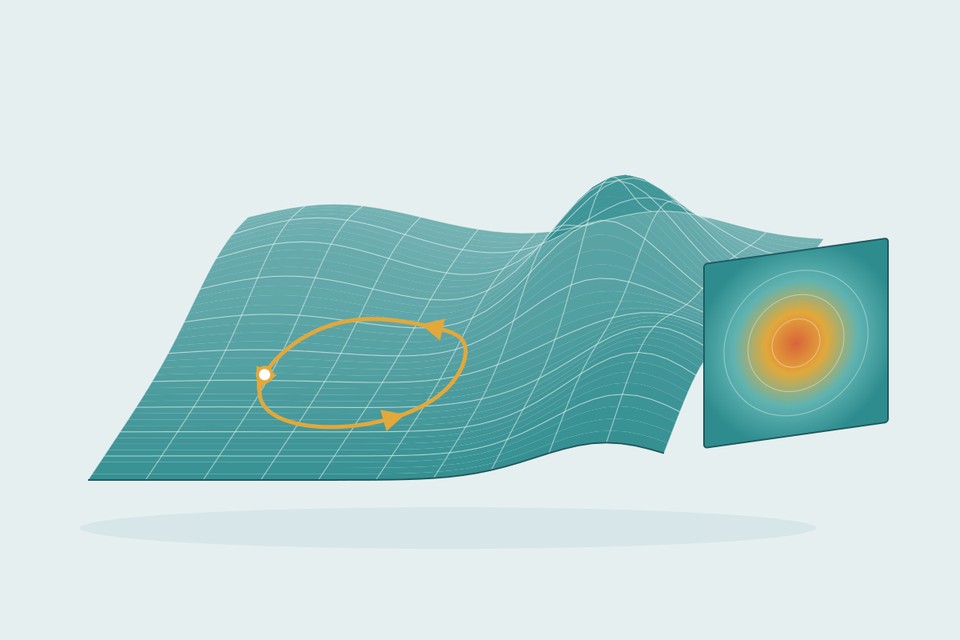
Heat capacity is one of the oldest probes in physics: it tells how a system takes up heat when its temperature changes. I develop the theory of heat capacity for systems kept away from equilibrium, such as driven, active and living matter, and work on how to measure it.
About this research
A steady nonequilibrium system keeps producing heat even when nothing is changed. When the temperature of its environment is raised slowly by a small amount, the system relaxes to a new steady state and, on top of the steady dissipation, releases or absorbs an extra amount of heat: the excess heat. The nonequilibrium heat capacity is this excess heat per degree of temperature change. It reduces to the usual heat capacity in equilibrium, but it can behave very differently.
In particular, stable nonequilibria can have negative heat capacities. The sign reflects an anticorrelation between the excess heat and the change in how the states are populated, the point where the Clausius and Boltzmann entropies separate. We compute heat capacities exactly for active particles and driven walkers on graphs, show that for a chain of oscillators between two baths the heat capacity becomes a matrix, and give quantitative predictions for biophysical models of cilia and molecular motors, where biological activity can make the heat capacity negative.
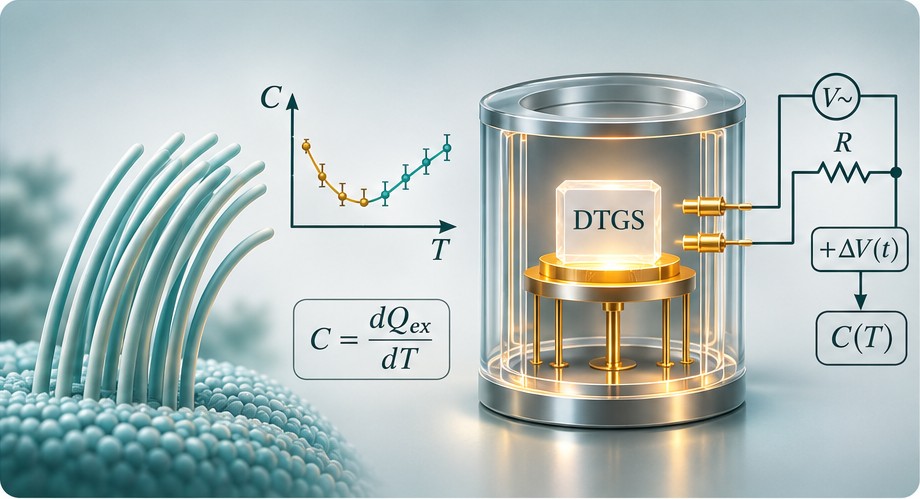
Measuring these heat capacities is a challenge, because the steady heat flux can be much larger than the excess heat. AC-calorimetry separates the two: the bath temperature is modulated periodically, and the part of the heat-flux response that is out of phase with the modulation gives the heat capacity. Natural test systems include ferroelectric crystals of the TGS family, such as the DTGS crystal studied in a student experiment at KU Leuven, and living cells, whose heat output lies close to the sensitivity of modern microcalorimeters.
Publications
- 2026
- 2026
Specific heat of thermally driven chains
M. Gautama, F. Khodabandehlou, C. Maes, I. Santra
J. Non-Equilib. Thermodyn. (2026)
- 2025
Negative specific heats: where Clausius and Boltzmann entropies separate
L. Bogers, F. Khodabandehlou, C. Maes
Phys. Chem. Chem. Phys. 27(28), 15009–15023 (2025), arXiv:2503.15999
- 2024
Local detailed balance for active particle models
F. Khodabandehlou, C. Maes
J. Stat. Mech. 063205 (2024), arXiv:2310.14059
- 2022
Exact computation of heat capacities for active particles on a graph
F. Khodabandehlou, S. Krekels, I. Maes
J. Stat. Mech. 2022, 123208 (2022), arXiv:2207.11070